Even more, still free.
Beyond the top five, a collection of free tools to group your spending, manage several bank accounts and keep an eye on your money health.
Add labels to your income and expenditure
Labels are a simple but powerful way to group related income and expenditure together.
Perhaps you have a side hustle and want to follow its activity across several income and expenditure categories. The same goes for anything related: your children, your pets, or even who in your household spends the most!
Whatever your reason for grouping items, you can do it from the banks and labels page.
Go to banks and labels
Use formulas for target bank balances
iBudge is particularly well suited to anyone with more than one bank account.
Plenty of features help you manage which money should be in which account, and formulas for target balances are a key part of that.
Build a formula from a huge combination of inputs: money in savings pots, money in another account, money you've set aside as a bonus, the time since a certain date and more. The simple interface makes formulas quick to create and edit.

Capture regular balance transfers
With more than one account, you probably move money between them after every payday. iBudge works out how much, and reminds you to do it.
Once your income and expenditure have their bank accounts and labels, your balance sheet breaks down the totals, and you can filter them by account or label.
Those filters show you straight away which transfers are needed. Set them up on the balance transfers tab and iBudge will remind you to make them (adjusting if needed) after every payday.

Track credit cards and loans
The free plan also tracks spending and repayments against your credit cards and loans.
- Familiar and simple. Add cards and loans, then track every transaction against them.
- The full picture. Cards and loans appear alongside your savings pots, in both the simple and matrix views.

Check the status of your finances
iBudge keeps watch over your financial wellbeing, so you always know the state of your money health.
The status header in the menu shows an amber or red indicator, depending on severity, whenever something needs attention.
Click it to open your status check: a complete breakdown of every part of your financial health, with recommendations for fixing any issues.

See a report of your finances
Everyone, including free users, gets the headlines report: income and expenditure against each pot over a period you choose (a year by default).
The report opens as a table; switch to the chart tab to see it visually. Use "Options" to change the timeframe, or to show only income or only expenditure.
Premium users also get a wide range of further reports and dashboards.
Go to the headlines report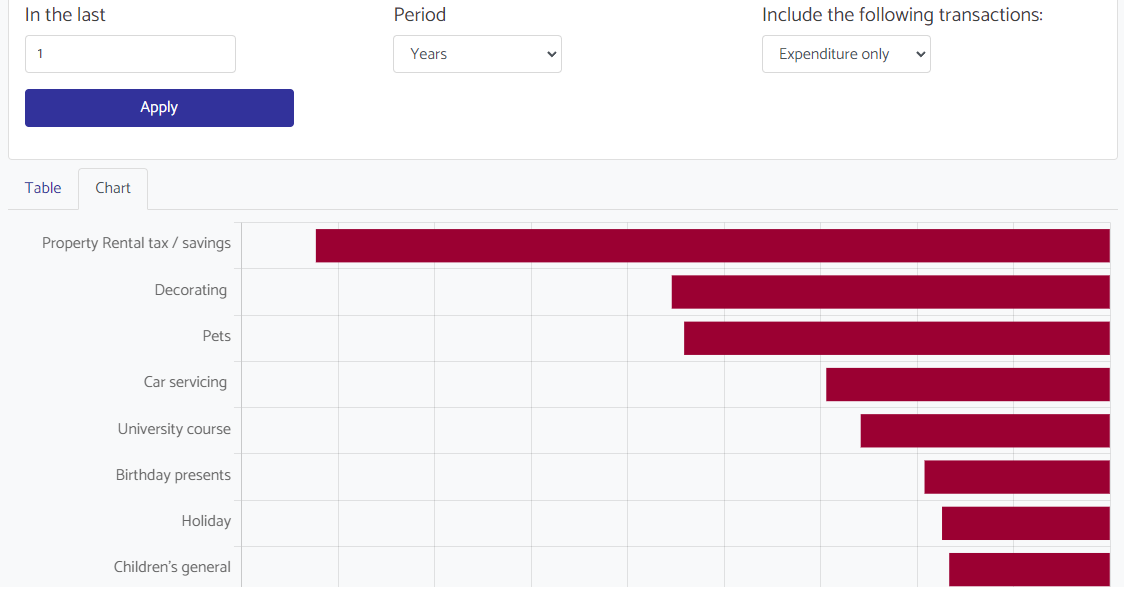
Ready for even more?
Premium adds scenario planning, investments, pensions, property, imports and advanced reports.